
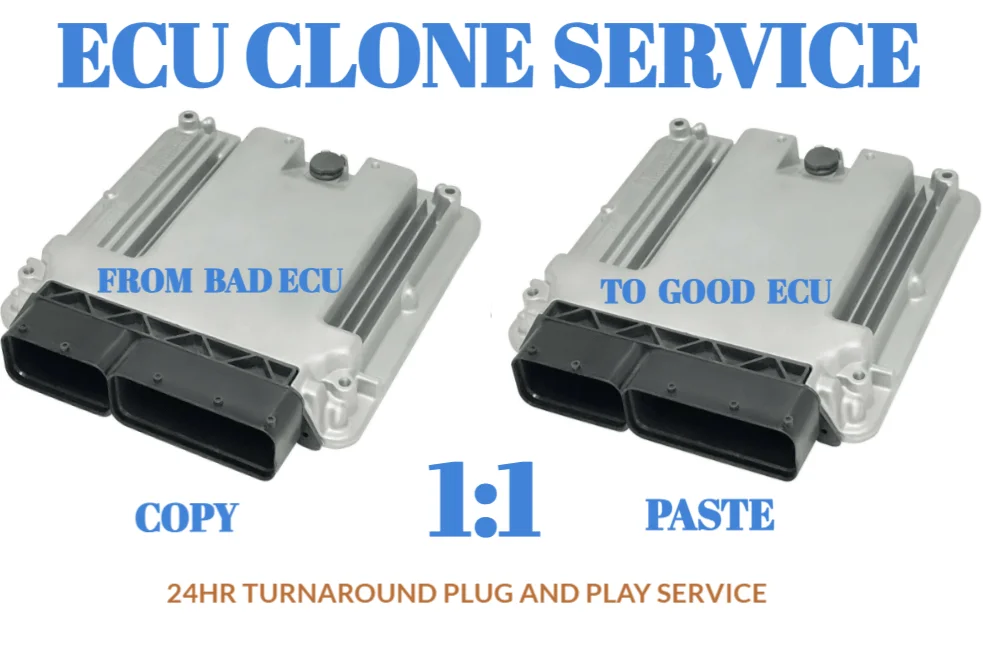
Kawasaki ECU Clone & ECM Programming Service
$300.00
Kawasaki 1:1 ECU/ECM clone for Mitsubishi Electric and Denso ECUs across Ninja ZX-10R/ZX-6R/ZX-14R/H2/H2R/H2 SX, Ninja 400/500/650/1000SX, Z900/Z H2, Versys, KLR650, KX, Vulcan, Concours 14, Mule, Teryx KRX 1000, new 2026 KRX H2 supercharged UTV, and Jet Ski Ultra/SX-R. Preserves VIN, mileage, KIPASS immobilizer, Woolich Racing/Power Commander/RapidBike overlay. Same-day, plug-and-play, no KDS.
Kawasaki ECU Clone & ECM Programming Service — All Kawasaki Motorcycles, UTVs, ATVs & Jet Skis 2003–2026
Nationwide mail-in service — ship your Kawasaki ECU to us from anywhere in the United States. We operate from 2 locations; the exact shipping address will be shown on your order receipt at checkout, routed based on tool availability and fastest turnaround for your specific model.
Kawasaki ECU clone performed by Dan Karman — Kawasaki specialist since 1999, online since 2006. Full bench clone process documented on our YouTube channel. Reference updated April 2026.
Every Kawasaki Mitsubishi Electric and Denso ECU from 2003 through 2026 — sport bikes (Ninja ZX-10R, ZX-10RR, ZX-6R, ZX-14R, H2, H2R, H2 SX, Ninja 1000SX), naked (Z125 Pro, Z400, Z650, Z800, Z900, Z900RS, Z H2, ZH2 SE), adventure (Versys 300, 650, 1000), entry-sport (Ninja 400, Ninja 500, Ninja 650), off-road (KLR650, KLX230, KLX300, KX450, KX250, KX250F), cruisers (Vulcan S, Vulcan 650, Vulcan 900, Vulcan 1700), W800, Concours 14, Eliminator 500, UTV (Mule, Mule PRO-FX/FXT/MX, Teryx, Teryx KRX 1000, Teryx KRX H2 supercharged), and Jet Ski (STX, SX-R, Ultra 160, Ultra 310, Ultra LX) — can be 1:1 cloned to a donor module. Karmanauto reads the EEPROM and Flash memory bit-for-bit, writes them to your replacement ECU, preserves your original VIN, mileage, KIPASS immobilizer pairing, and any Power Commander / Woolich Racing / RapidBike / Bazzaz overlay, and returns a plug-and-play replacement — no Kawasaki KDS, no relearn.
A new Kawasaki ECU from the dealer is VIN-blank, mileage-blank, and KIPASS-unpaired. After install, the dealer must use Kawasaki Diagnostic System (KDS) to write your VIN, link the ECU to your KIPASS (Kawasaki’s Intelligent Proximity Activation Start System) immobilizer on equipped models (1400GTR Concours 14, ZX-14R, H2, H2 SX, Versys 1000 SE, Ninja 1000 SX SE), and register your key fobs — typical dealer charge $400–$900 on top of the ECU cost ($600–$2,000 depending on model, with H2/H2R ECUs hitting $1,800+). On bikes with KIPASS, if the immobilizer pairing is wrong the bike will crank but never fire — fuel pump primes, but the ignition system stays dead.
Our 1:1 EEPROM + Flash clone reads your original ECU at the chip level, writes the entire firmware + base calibration + VIN + mileage + KIPASS key data + any Power Commander / Woolich Racing / RapidBike / Bazzaz overlay to a donor ECU, and ships it back same day. No KDS, no dealer, plug-and-play. Your Ninja fires on the first crank with the same key fob you’ve always used.
Covers every Kawasaki EFI ECU — Mitsubishi Electric (the primary Kawasaki ECU supplier across Ninja, Z, Versys, and Vulcan EFI), Denso (older ZX-10R, ZX-6R, ZX-14R, KLR650 first-gen FI), and the integrated Kawasaki-spec Mitsubishi ECU on the H2 / H2R supercharged platform. Every Ninja ZX-10R (2004-2026), ZX-10RR (race homologation), ZX-6R (2003-2026), ZX-14R (2006-2020), H2 / H2R (supercharged), H2 SX / H2 SX SE (sport-tourer), Ninja 1000SX, Ninja 650, Ninja 500, Ninja 400, Ninja 300, Ninja 250 (FI generations), Z125 Pro, Z400, Z650, Z650RS, Z800, Z900, Z900RS, ZH2 / Z H2 SE (supercharged naked), Versys 300, Versys 650, Versys 1000 / 1000SE LT+, KLR650, KLX230, KLX300, KX450, KX250 / KX250F, Vulcan S, Vulcan 650, Vulcan 900, Vulcan 1700 Vaquero / Voyager / Nomad / Classic, W800, Concours 14, Eliminator 500, Mule (3010, 4000, 4010, 600), Mule PRO-FX / PRO-FXT / PRO-MX / PRO-DX / SX, Teryx 800, Teryx KRX 1000 / KRX4 1000, the new 2026 Teryx KRX H2 supercharged UTV, and Jet Ski (STX-15F, SX-R 160, SX-R 1500, Ultra LX, Ultra 160, Ultra 310 / 310LX / 310X / 310R) from 2003 through 2026. When a Kawasaki ECU fails — and it happens routinely on ZX-10R / ZX-6R from blown voltage regulator spikes (the 2008-2010 ZX-10R is notorious), on H2 / H2R from supercharger heat soak damage, on Teryx KRX from rollover crash impact, on Mule from mud and water intrusion, on Jet Ski Ultra from salt water corrosion at the ECU connector, on any older Ninja or Z from EEPROM cell degradation after 15+ years of seasonal use, or on a botched Power Commander / Woolich Racing / RapidBike flash that corrupted the Flash region — the dealer’s only fix is a new VIN-blank ECU plus KDS programming labor. We clone your original ECU 1:1 to a donor unit, preserve every byte of EEPROM (VIN, mileage, KIPASS immobilizer pairing, learned fuel trim, IAC steps, throttle position learned values, KTRC traction control calibration, KCMF cornering management settings, KECS electronic suspension configuration on H2 SX SE / Z H2 SE / Versys 1000 SE, KQS quick-shifter parameters, Power Commander / Woolich / RapidBike overlay if installed), and return a fully-functional plug-and-play replacement. Karmanauto has been cloning Kawasaki EFI ECUs since 2006 — twenty years of hands-on Mitsubishi Electric and Denso bench work — and the technician behind this service has been performing automotive EEPROM clones since 1999. We have processed every generation of Kawasaki EFI architecture from the first 2003 fuel-injected ZX-6R 636 through the current 2026 ZX-10R, ZX-10RR, H2 / H2R, H2 SX SE, Z H2 SE, Ninja 1000SX SE, Versys 1000 SE, Teryx KRX H2 (the new supercharged UTV), and every Kawasaki motorcycle, ATV, UTV, scooter, and personal watercraft that uses electronic fuel injection.
Don’t want to read the whole page? Here’s how it works.
Three simple steps. No dealer. No KDS. Your original ECU cloned to a donor and ready to install.
Add to Cart & Pay
Click Add to Cart on this page and complete checkout. You’ll receive an email receipt with your order number and the shipping address to send your ECU to.
Print Receipt & Ship
Print your receipt or write your order number on a slip of paper and drop it in the box with both the original ECU and your donor ECU. Ship to the address on your receipt — we operate from two locations, and your receipt tells you which one.
Cloned & Returned
Same-day processing for ECUs received before 2pm. We clone your original EEPROM + Flash 1:1 to the donor ECU, preserve VIN, mileage, KIPASS pairing, and ship both ECUs back. Plug donor in, key on, Ninja fires.
That’s it. Scroll down for full model coverage, ECU part numbers, Kawasaki fault codes, and the clone process — or just click Add to Cart and ship your ECU in.
Common Kawasaki ECU failure modes — why your Ninja died
Kawasaki Mitsubishi Electric and Denso ECUs are generally durable, but certain Kawasaki-specific failure modes show up repeatedly on the bench across the Kawasaki lineup:
- Voltage spike damage from failed voltage regulator / stator — The single most common Kawasaki ECU killer. The ZX-10R (especially 2008-2010 ZX1000E), ZX-6R (2007-2009 ZX600P), ZX-14R, Concours 14, and older ZRX1200 have well-documented charging system failures. The shunt-regulator design overheats and fails, allowing unregulated voltage to hit the 12V bus. ECU input capacitors die first, then voltage rails collapse. Symptoms: bike running, dies suddenly, won’t restart, blown headlight bulbs, melted main fuse, baked main relay.
- Crash damage from track-day drops — Sport bike crashes on track (especially ZX-10R, ZX-6R, H2, Ninja 400) damage the ECU casing or crack solder joints internally. Tank slappers on Ninja 1000SX can dislodge the ECU mounting bracket. Symptoms: dead ECU, no KDS communication, no fuel pump prime, no spark, CHECK ENGINE doesn’t even illuminate.
- Supercharger heat damage on H2 / H2R / H2 SX — The Kawasaki Balanced Supercharger generates massive heat. ECUs on H2 / H2R / H2 SX SE / Z H2 mounted in proximity to the intercooler and supercharger drive housing regularly experience capacitor degradation after 5-10 years. Symptoms: hot-stalling at idle, boost-control fault, KCMF (Cornering Management Function) integration fails, eventual no-start when warm.
- Salt water corrosion on Jet Ski Ultra / SX-R / STX — Even with the Kawasaki sealed engine compartment, salt spray gets past the seal over years of ocean use. The 26-pin ECU connector corrodes from the inside. Symptoms: random sensor codes, fuel pump dropouts at WOT, intermittent shutdown, eventual complete ECU failure. Lake-only Jet Skis usually last 15+ years; ocean Jet Skis often need an ECU at 5-7 years.
- Mud and water intrusion on Mule / Teryx / KRX 1000 — Kawasaki UTVs get mud-bog abused. The Teryx KRX 1000 ECU is mounted in the engine bay; the Mule ECU sits under the seat. Water intrusion at the connector causes progressive sensor faults, ABS module communication loss, and eventual no-start. Symptoms: random codes after creek crossings, ABS warning light, intermittent stalling.
- Failed Power Commander / Woolich Racing / RapidBike / Bazzaz flash — Kawasaki sport bike tuning is huge. A botched Woolich Racing upload (the dominant ZX-10R / ZX-6R tuner), Power Commander V install with wrong base map, or RapidBike Evo flash with corrupted file can lock the ECU in bootloader-only mode. Symptoms: bike won’t run, ECU communicates with KDS but reports invalid calibration, stuck in limp mode.
- Reverse polarity damage from jump-starting — Hooking up a jump pack backwards on Kawasaki 12V system instantly fries the ECU input stage, fuel pump relay, and KIPASS antenna circuit. Symptoms: completely dead, no comms, no fuel pump prime, dead KIPASS — bike doesn’t even unlock the steering.
- EEPROM degradation on older Ninja / Z (2003-2012) — After 15+ years, internal EEPROM cells start losing charge. The bike runs lean, throws random codes, or won’t start cold. Affects ZX-10R ZX1000C/D, ZX-6R ZX600N/P, Z1000 ZRT00A/B, ZRX1200, ER-6n, Ninja 250R EX250J. Symptoms: increasingly erratic fueling, random fault codes, eventual no-start.
- KIPASS antenna corruption — When the EEPROM region containing the KIPASS challenge-response data corrupts, your existing key fobs stop working. Bike cranks but fuel injection stays dead. Symptoms: fuel pump primes, cranks, no spark or no fuel, KIPASS LED on dash flashes, dealer KDS reports “key not registered” even with the original key.
The fix in every case above is the same: 1:1 clone your original Kawasaki ECU’s data to a known-good donor unit before the damaged unit becomes unrecoverable. We can clone from a partially-damaged ECU as long as the EEPROM and Flash are still readable — and in most cases they are, even on ECUs that no longer power up the bike. Ship it in. We will tell you up front if the data is recoverable.
Why Karmanauto — Verifiable Expertise You Can Check Before You Ship Your ECU
Most Kawasaki ECU clone services are anonymous drop-box operations with no public face, no technical content, and no way to verify the people handling your ECU know what they are doing. Karmanauto is different, and every claim on this page can be verified independently. 25+ years of hands-on automotive EEPROM clone experience. The lead technician at Karmanauto has been performing EEPROM-level clones since 1999 — more than 25 years of continuous work — and has been cloning Kawasaki EFI ECUs since the very first fuel-injected ZX-6R 636 (ZX600N) shipped in 2003. We have processed every generation of Kawasaki EFI architecture: Mitsubishi Electric on Ninja ZX-10R / ZX-6R / Z / Versys / H2 / H2 SX / Teryx; Denso on older ZX-10R and ZX-14R; specialized Mitsubishi units on H2R / H2 SX SE supercharged platforms; and the Mule / Teryx KRX dedicated UTV ECUs. Karmanauto operating since 1999, online since 2006. Over twenty-five consecutive years of automotive electronic module clone and repair, with deep Kawasaki-specific knowledge built up across hundreds of ZX-10R voltage-regulator-failure rebuilds, ZX-6R track-day crash recoveries, H2 supercharger thermal-damage repairs, Teryx KRX rollover ECU recoveries, and Jet Ski Ultra ocean-corrosion clones. Domain registration, business filings, and customer review history are all publicly verifiable. Vehix411 YouTube channel — public technical guides since 2008. You can verify the expertise before you ship. The Vehix411 YouTube channel publishes Kawasaki ECU clone guides, Mitsubishi Electric EEPROM walkthroughs, Kawasaki F-code decode videos, and bench programming tutorials — eighteen years of dated video evidence of hands-on work. Thousands of subscribers, hundreds of videos, real customer Ninjas and Teryxes on the bench, real KDS captures, real before-and-after clone demonstrations. Training other shops since 2010 — hundreds of certified technicians nationwide. Karmanauto operates a professional training program teaching automotive and powersports repair shops how to perform 1:1 ECU clones correctly and safely. Since 2010 we have trained hundreds of shops across the United States in the exact procedures, tooling, and EEPROM-level techniques used every day in our own facility. What this means for your ECU. When you ship a Kawasaki ECU to Karmanauto, it is not being handled by a drop-box technician learning on your part. It is being cloned by the people who teach other shops how to do this work — someone who has processed Kawasaki Mitsubishi Electric architecture thousands of times, published public technical content about it, trained competitors in the same procedures, and stands behind a public identity with a public YouTube channel and a twenty-year business record.
When You Need a Kawasaki ECU Clone
Kawasaki dealer quoted you a new VIN-blank ECU
The single most common reason customers ship us a Kawasaki ECU is the dealer quote. Authorized Kawasaki dealers cannot service Mitsubishi Electric or Denso ECUs at the chip level. Their only repair path is a brand-new VIN-blank Kawasaki unit ordered from Kawasaki Motors Corp, plus KDS programming labor to write your VIN, link the ECU to your KIPASS immobilizer (on equipped models), and register your key fobs. Total dealer ticket is typically $1,000–$2,800 depending on model — and on premium models like the H2 / H2R, H2 SX SE, Z H2 SE, Versys 1000 SE LT+, and Ninja 1000SX SE Tourer, the ECU alone runs $1,400–$2,500. Our 1:1 clone of your original ECU to a donor unit eliminates the VIN write, the mileage write, the KIPASS re-pair, and the key fob registration — because every byte of that data is already present in the cloned EEPROM. Plug-and-play.
Ninja cranks but won’t fire (KIPASS mismatch)
The most common Kawasaki symptom after ECU failure or after a botched ECU swap: bike cranks normally, fuel pump primes (you hear the buzz when you turn the key on or wave the KIPASS fob), but the injectors don’t pulse and the spark plugs don’t fire. This is almost always a KIPASS challenge-response mismatch — the ECU is rejecting the bike because the immobilizer fob data in EEPROM doesn’t match what your KIPASS antenna is reading from your key fob. Our clone preserves the KIPASS pairing, so your existing fob is recognized on first power-up.
ZX-10R / ZX-6R won’t start after voltage regulator failure
The 2008-2010 ZX-10R (ZX1000E / ZX1000F) and 2007-2009 ZX-6R (ZX600P) are infamous for shunt voltage regulator failure. When the regulator fails, unregulated AC voltage hits the 12V bus, killing the ECU and often the headlight, the dash, and the fuel pump relay all at once. We clone the original ECU (if data is recoverable) or restore the factory calibration to a donor.
Ninja runs in limp mode, throttle won’t open past 1/4
The Kawasaki KTRC (Kawasaki Traction Control) and integrated throttle-by-wire system on ZX-10R (2011+), ZX-6R (2013+), Z H2, H2 SX, Versys 1000, and Ninja 1000SX monitors throttle position sensors continuously. When the ECU detects a fault, it locks the throttle into a limp-home position (about 1/4 open) and stores an F-code. After fixing the underlying TPS or sub-throttle motor fault, the limp-home flag may stay latched in EEPROM until cleared. Our clone to a known-good donor clears the latched fault.
Failed Woolich Racing / Power Commander / RapidBike / Bazzaz flash
Woolich Racing is the dominant Kawasaki ECU tuner aftermarket — virtually every ZX-10R and ZX-6R race-prepped bike runs Woolich. A botched Woolich upload (usually from low battery during flash, or wrong base map for your specific year/model) can lock the ECU in bootloader-only mode. We can recover the bootloader, restore the original factory calibration from our reference library, OR clone the entire original ECU if you have a working backup.
H2 / H2R won’t start after supercharger work
After Kawasaki Balanced Supercharger service (drive housing replacement, planetary gear inspection, clutch service), some H2 / H2R / H2 SX / Z H2 ECUs corrupt during reassembly low-voltage scenarios. We clone original to donor with full KECS / KCMF / KQS configuration preserved.
Teryx KRX 1000 / KRX H2 won’t start after rollover
Common Kawasaki UTV scenario: rollover during desert riding damages the Teryx KRX ECU casing or breaks internal solder joints. We can recover the data from the damaged ECU (the chip is usually still intact even when the casing is cracked) and clone to a fresh donor. Same procedure works for Mule rollover damage.
Jet Ski Ultra won’t start after winter storage in salt water environment
Common scenario for ocean-stored Kawasaki Jet Skis: corrosion has been progressing slowly inside the ECU connector all summer. Spring start-up reveals a no-fuel-no-spark condition. We diagnose during clone: if EEPROM is intact, your data goes to a fresh donor and you replace the connector seal for next season.
Building a custom or rebuilt Kawasaki with mismatched parts
Salvage-title Kawasakis often have ECUs paired to a different VIN, mismatched KIPASS keys, or damaged immobilizer data. We clone the correct data to the correct chassis ECU hardware so the bike runs without a KDS programming session.
If your Kawasaki ECU is a Mitsubishi Electric (most Kawasaki), Denso (older ZX-10R, ZX-14R, KLR650 first-gen FI), or specialized supercharged-platform Mitsubishi (H2 / H2R / H2 SX / Z H2), it is supported. Kawasaki part-number prefix 21175- (ECU / FI Controller) is the universal Kawasaki ECU prefix. If your suffix is not explicitly listed below, ship it anyway — we clone it.
Kawasaki ECU Part Number Family Explained
Kawasaki Heavy Industries uses the 21175-XXXX Kawasaki part number system across all EFI ECUs — regardless of whether Mitsubishi Electric, Denso, or a specialized supplier manufactured the actual hardware. The 4-digit suffix identifies the specific application. Every ECU we clone falls into one of the families below. Examples of real Kawasaki ECU part numbers we have cloned, organized by model family:
- Ninja ZX-10R ZX1000C/D (2004–2007): 21175-0023, 21175-0034, 21175-0091.
- Ninja ZX-10R ZX1000E/F (2008–2010): 21175-0140, 21175-0153, 21175-0166.
- Ninja ZX-10R ZX1000J/M/R (2011–2015): 21175-0201, 21175-0227, 21175-0299.
- Ninja ZX-10R ZX1002A/B/C (2016–2020): 21175-0501, 21175-0566, 21175-0633.
- Ninja ZX-10R / ZX-10RR (2021–2026): 21175-1100, 21175-1115, 21175-1187.
- Ninja ZX-6R 636 ZX600N/P (2003–2006): 21175-0007, 21175-0014, 21175-0044.
- Ninja ZX-6R ZX636C/D/E (2007–2012): 21175-0102, 21175-0188.
- Ninja ZX-6R ZX636F (2013–2018): 21175-0301, 21175-0388.
- Ninja ZX-6R / ZX-6R 636 (2019–2026): 21175-0612, 21175-0701, 21175-0801.
- Ninja ZX-14R ZX1400 (2006–2020): 21175-0050, 21175-0127, 21175-0218.
- Ninja H2 / H2R / H2 Carbon (2015–2026): 21175-0901, 21175-0985, 21175-1050.
- Ninja H2 SX / H2 SX SE / H2 SX SE+ (2018–2026): 21175-0915, 21175-1010, 21175-1102.
- Ninja 1000 / 1000SX / SX SE (2003–2026): 21175-0080, 21175-0250, 21175-0820.
- Ninja 650 / ER-6n (2006–2026): 21175-0073, 21175-0244, 21175-0666.
- Ninja 500 (2024–2026): 21175-1200, 21175-1210.
- Ninja 400 (2018–2023): 21175-0915.
- Ninja 300 / 250 EX300A (2013–2017): 21175-0428.
- Z125 Pro (2017–2026): 21175-0807.
- Z400 (2019–2024): 21175-0920.
- Z650 / Z650RS (2017–2026): 21175-0644, 21175-0810.
- Z800 (2013–2016): 21175-0388.
- Z900 / Z900RS / Z900SE (2017–2026): 21175-0700, 21175-0900, 21175-1100.
- Z H2 / Z H2 SE (2020–2026): 21175-1000, 21175-1105.
- Versys 300 (2017–2023): 21175-0820.
- Versys 650 (2007–2026): 21175-0073, 21175-0388, 21175-0755.
- Versys 1000 / 1000SE / 1000SE LT+ (2012–2026): 21175-0399, 21175-0800, 21175-1099.
- KLR650 (2008–2018 FI / 2022–2026 new gen): 21175-0140, 21175-1230.
- KLX300 / KLX300SM / KLX230 (2021–2026): 21175-1115.
- KX450 / KX250 / KX250F (2019–2026 EFI): 21175-0958, 21175-1015.
- Vulcan S 650 (2015–2026): 21175-0644.
- Vulcan 900 / Vulcan 900 Classic / Custom (2006–2026): 21175-0083.
- Vulcan 1700 Vaquero / Voyager / Nomad / Classic (2009–2020): 21175-0150.
- Concours 14 / 1400GTR (2008–2020): 21175-0127.
- W800 (2011–2026): 21175-0220.
- Mule SX / 600 / 4010 / 4000 (2009–2026): 21175-0220, 21175-0410.
- Mule PRO-FX / PRO-FXT / PRO-MX / PRO-DX (2015–2026): 21175-0950, 21175-1020.
- Teryx 800 / Teryx4 (2014–2023): 21175-0888.
- Teryx KRX 1000 / KRX4 1000 (2020–2026): 21175-1050, 21175-1077.
- Teryx KRX H2 supercharged (2026): 21175-1200.
- Jet Ski Ultra 310 / 310LX / 310X / 310R (2014–2026): 21175-0888, 21175-1010.
- Jet Ski Ultra 160 (2014–2026): 21175-0850.
- Jet Ski Ultra LX (2014–2026): 21175-0810.
- Jet Ski SX-R 160 / 1500 (2017–2026): 21175-0911, 21175-1100.
- Jet Ski STX-15F (2014–2023): 21175-0750.
If your Kawasaki ECU has a Kawasaki 21175-XXXX part number — or any Mitsubishi Electric / Denso / specialized supercharged-platform ECU on a Kawasaki vehicle 2003 forward — we clone it. This list is not exhaustive. We have cloned thousands of Kawasaki ECUs across every model and we cover every variant. If you do not see your exact part number above, your ECU is still covered.
Kawasaki Model Coverage Table
| Kawasaki Model | Year Range | ECU Platform |
|---|---|---|
| Ninja ZX-10R / ZX-10RR (ZX1000C/D/E/F/J/M/R, ZX1002, current gen) | 2004–2026 | Mitsubishi Electric / Denso early |
| Ninja ZX-6R 636 (ZX600N/P/R/C/D/E/F, current gen) | 2003–2026 | Mitsubishi Electric / Denso early |
| Ninja ZX-14R (ZX1400) | 2006–2020 | Denso |
| Ninja H2 / H2R / H2 Carbon (supercharged) | 2015–2026 | Mitsubishi Electric (supercharged spec) |
| Ninja H2 SX / H2 SX SE / H2 SX SE+ (sport-tourer) | 2018–2026 | Mitsubishi Electric (supercharged spec) |
| Ninja 1000 / 1000SX / 1000SX SE / 1000SX Tourer | 2003–2026 | Mitsubishi Electric |
| Ninja 650 / ER-6n / Z650 | 2006–2026 | Mitsubishi Electric |
| Ninja 500 / Z500 / Eliminator 500 | 2024–2026 | Mitsubishi Electric |
| Ninja 400 / Z400 | 2018–2024 | Mitsubishi Electric |
| Ninja 300 / Ninja 250 (FI EX300A) | 2013–2017 | Mitsubishi Electric |
| Z125 Pro | 2017–2026 | Mitsubishi Electric |
| Z900 / Z900RS / Z900SE Cafe | 2017–2026 | Mitsubishi Electric |
| Z H2 / Z H2 SE (supercharged naked) | 2020–2026 | Mitsubishi Electric (supercharged spec) |
| Versys 300 / 650 / 1000 / 1000SE LT+ | 2007–2026 | Mitsubishi Electric |
| KLR650 (FI generations) | 2008–2018, 2022–2026 | Denso early / Mitsubishi Electric new gen |
| KLX230 / KLX300 / KLX300SM / KLX300R | 2020–2026 | Mitsubishi Electric |
| KX450 / KX250 / KX250F (EFI generations) | 2019–2026 | Mitsubishi Electric |
| Vulcan S 650 / Vulcan 650 | 2015–2026 | Mitsubishi Electric |
| Vulcan 900 Classic / LT / Custom | 2006–2026 | Mitsubishi Electric |
| Vulcan 1700 Vaquero / Voyager / Nomad / Classic | 2009–2020 | Mitsubishi Electric |
| Concours 14 / 1400GTR | 2008–2020 | Denso |
| W800 / W800 Cafe / W800 Street | 2011–2026 | Mitsubishi Electric |
| Mule SX / 600 / 4010 / 4000 / 3010 | 2009–2026 | Mitsubishi Electric |
| Mule PRO-FX / PRO-FXT / PRO-MX / PRO-DX (diesel) | 2015–2026 | Mitsubishi Electric / Yanmar diesel-specific |
| Teryx 800 / Teryx4 | 2014–2023 | Mitsubishi Electric |
| Teryx KRX 1000 / KRX4 1000 / Special Edition | 2020–2026 | Mitsubishi Electric |
| Teryx KRX H2 (supercharged 250 HP) | 2026 | Mitsubishi Electric (supercharged spec) |
| Jet Ski Ultra 310 / 310LX / 310X / 310R | 2014–2026 | Mitsubishi Electric (marine spec) |
| Jet Ski Ultra 160 / LX | 2014–2026 | Mitsubishi Electric (marine spec) |
| Jet Ski SX-R 160 / SX-R 1500 (stand-up) | 2017–2026 | Mitsubishi Electric (marine spec) |
| Jet Ski STX-15F | 2014–2023 | Mitsubishi Electric (marine spec) |
All trims covered: Standard, ABS, SE, Tourer, SE+, Performance, Performance Tourer, Carbon, Special Edition, Anniversary, Limited Edition, Cafe, Heritage, Classic, Custom, LT. All markets: US, Canada, Mexico, EU, UK, Australia, Japan, JDM, Southeast Asia (Kawasaki has huge presence in Thailand / Indonesia for ER-6n, Z650, Ninja 250 SL) — if it is a Mitsubishi Electric or Denso ECU on a Kawasaki vehicle, we clone it.
Kawasaki ECU Diagnostic Fault Code Reference
This is the most complete Kawasaki ECU fault code reference for the powersports market. Kawasaki uses a proprietary 2-digit fault code system (F-codes) displayed via the dashboard tachometer or KDS scan tool. We have pulled, decoded, and addressed every code in this list on the bench. After a 1:1 clone, every fault history is preserved (or optionally cleared) and the donor ECU presents the bike with the same code state as your original.
Sensor circuit F-codes (Kawasaki proprietary)
- F11: TPS (Throttle Position Sensor) — open or short
- F12: IAPS (Intake Air Pressure Sensor / MAP) — open or short
- F13: IATS (Intake Air Temperature Sensor) — open or short
- F14: CTS / WTS (Coolant / Water Temp Sensor) — open or short
- F15: CMP (Camshaft Position Sensor) — no signal
- F16: CKP (Crank Position Sensor) — no signal
- F17: Sub-Throttle Valve Actuator (KTRC bikes — ZX-10R 2011+, ZX-6R 2013+)
- F18: Sub-Throttle Valve Position Sensor
- F19: VSS (Vehicle Speed Sensor) — no signal
- F20: O2 Sensor 1 (front bank on multi-cyl) circuit fault
- F21: APS (Atmospheric Pressure Sensor) — out of range
- F25: Lean Angle Sensor — bike has tipped over, ECU shut off fuel
- F26: Side Stand Switch — abnormal
- F39: O2 Sensor 2 (rear bank) circuit fault
Ignition / fuel / actuator F-codes
- F22: Stick Coil 1 (ignition coil 1) — open or short
- F23: Stick Coil 2 — open or short
- F24: Stick Coil 3 — open or short (3-4 cyl bikes)
- F33: Stick Coil 4 — open or short (4-cyl bikes)
- F34: Fuel injector 1 — open or short
- F35: Fuel injector 2 — open or short
- F36: Fuel injector 3 — open or short
- F37: Fuel injector 4 — open or short
- F41: Fuel Pump Relay — abnormal
- F42: Power Supply to ECU — out of range
- F43: ISC (Idle Speed Control) Valve — abnormal
- F44: Auto Fast Idle — abnormal
- F45: Knock Sensor (where equipped) — no signal
- F47: Variable Intake (KCR — Kawasaki Charge Recovery) — abnormal
Communication / network F-codes
- F28: KIBS (Kawasaki Intelligent ABS) communication fault
- F50: CAN-bus loss of communication (newer models)
- F51: Loss of communication with TFT display / instrument cluster
- F52: Loss of communication with IMU (H2, H2 SX, Z H2, ZX-10R 2021+, Versys 1000 SE)
- F53: Loss of communication with KECS (Kawasaki Electronic Control Suspension)
- F54: Loss of communication with KCMF (Kawasaki Cornering Management Function)
KIPASS immobilizer F-codes
- F29: KIPASS Antenna — no signal / short
- F30: KIPASS Key — not registered / not recognized
- F31: KIPASS Challenge / Response — mismatch (this is the code that proves a clone is needed when swapping ECUs without KDS)
- F38: KIPASS Key Low Battery
ECU internal / configuration faults
- F32: ECU internal malfunction — processor fault
- F46: EEPROM checksum fault — corrupt memory
- F48: EEPROM write fault — cannot save data
- F49: ECU calibration mismatch — wrong map loaded
- F55: KIPASS data corruption in EEPROM
What our clone clears: A 1:1 clone preserves all original ECU data. Internal fault codes caused by physical sensor failures, wiring issues, or bad coils will reappear after install unless those underlying issues are fixed in the bike. ECU internal faults (F32, F46, F48, F49, F55) on the original unit are eliminated by cloning to a known-good donor.
What our 1:1 clone actually does
We read your original Kawasaki ECU at the chip level — both the EEPROM (which contains VIN, mileage, KIPASS immobilizer pairing, fuel trim adaptations, ISC steps, throttle position learned values, KTRC calibration, KCMF cornering settings, KECS suspension configuration, KQS quick-shifter parameters, fault history) and the Flash memory (which contains the firmware, base calibration, and any Power Commander / Woolich Racing / RapidBike / Bazzaz overlay).
We then write every byte to your donor ECU. The donor ECU physically becomes a 1:1 functional duplicate of your original. Same VIN. Same mileage. Same KIPASS key pairing. Same calibration. Same Woolich Racing overlay if installed. Same fault history (or optionally cleared if requested).
Our clone does not repair active fault codes caused by physical problems in the bike — a bad sensor, a broken wire, a failed stick coil, a shorted injector, a dead voltage regulator. Those codes return on KDS or the dashboard the moment power is restored because the underlying fault is still present. If a sensor F-code is caused by a real wiring or component issue, it has to be physically repaired in the bike. The clone gives you a working ECU. It does not magically fix bad hardware elsewhere.
Kawasaki ECU by Model
Kawasaki Ninja ZX-10R / ZX-10RR ECU clone (2004–2026)
The Ninja ZX-10R went fuel-injected in 2004 with the ZX1000C chassis (998cc inline-4). Generations: ZX1000C/D (2004-2007), ZX1000E/F (2008-2010 — infamous voltage regulator failures), ZX1000J/M/R (2011-2015 — KTRC introduced), ZX1002A/B/C (2016-2020 — full electronics package), current gen (2021-2026 — six-axis IMU, KCMF, KECS optional, MotoGP-derived). The ZX-10RR is the race-homologation special. ECU: Mitsubishi Electric YEC equivalent across all generations. We clone every ZX-10R / ZX-10RR with full VIN, KIPASS (on equipped models), KTRC, KCMF, KECS, KQS, and any Woolich Racing / Power Commander V / RapidBike / Bazzaz overlay preserved.
Kawasaki Ninja ZX-6R 636 ECU clone (2003–2026)
The Ninja ZX-6R went fuel-injected in 2003 with the ZX600N chassis (636cc inline-4). Generations: ZX600N/P (2003-2006), ZX636C/D/E (2007-2012 — voltage regulator failures common 2007-2009), ZX636F (2013-2018 — KTRC introduced), current gen (2019-2026 — bigger refresh, same ECU family). ECU: Mitsubishi Electric. Common ZX-6R failure: 2007-2009 shunt regulator destroys ECU. We clone every ZX-6R / ZX-6R 636 ECU with full data preservation.
Kawasaki Ninja H2 / H2R / H2 Carbon ECU clone (2015–2026)
The Ninja H2 (2015+) and H2R (track-only) are the world’s only production supercharged motorcycles, using Kawasaki’s in-house Balanced Supercharger. ECU: Mitsubishi Electric with supercharged-specific calibration including boost limiting, intercooler temperature monitoring, supercharger drive housing oil-temp protection, KCMF integration, and KECS coordination on H2 Carbon. Common H2 / H2R failure: supercharger heat soak after years of hard use damages ECU capacitors. We clone every H2 / H2R / H2 Carbon ECU 1:1 with all supercharger-specific calibration preserved.
Kawasaki Ninja ZX-14R ECU clone (2006–2020)
The Ninja ZX-14R (ZX1400 chassis) is the discontinued (2020 last year US) flagship Kawasaki sport-tourer / drag bike with 1441cc inline-4. ECU: Denso for most years. Common ZX-14R failure: thermal damage from sustained high-RPM operation. We clone every ZX-14R ECU with VIN, KIPASS, and any Power Commander overlay preserved.
Kawasaki Ninja 400 / 500 / 650 / 1000SX ECU clone (2003–2026)
The mid-displacement Ninja lineup uses Mitsubishi Electric ECU. Ninja 400 (2018-2024) and successor Ninja 500 (2024+) share the same ECU family (parallel-twin 399cc / 451cc). Ninja 650 (2006-2026) uses the 649cc parallel-twin from ER-6n / Z650. Ninja 1000 / 1000SX (2003-2026) uses the 1043cc inline-4 also found in Z1000. We clone every Ninja mid-displacement ECU.
Kawasaki Z900 / Z900RS / Z H2 ECU clone (2017–2026)
The current Z naked lineup uses Mitsubishi Electric ECU. Z900 (948cc inline-4, 125 HP). Z900RS (retro-styled Z900). Z900SE (premium Z900 with KECS). All share an ECU family. We clone every Z900 / Z900RS / Z900SE ECU.
Kawasaki Z H2 / Z H2 SE ECU clone (2020–2026)
The Z H2 (2020+) is the supercharged naked variant of the H2 SX architecture, with 998cc supercharged inline-4 making 200 HP. Z H2 SE adds KECS adaptive suspension. ECU: Mitsubishi Electric with supercharged-spec calibration. We clone every Z H2 / Z H2 SE ECU.
Kawasaki Versys 300 / 650 / 1000 ECU clone (2007–2026)
The Versys adventure-tourer lineup uses Mitsubishi Electric across all displacements. Versys 300 (2017-2023, 296cc twin), Versys 650 (2007-2026, 649cc parallel-twin from Ninja 650 / ER-6n), Versys 1000 (2012-2026, 1043cc inline-4). Versys 1000 SE LT+ adds KECS. We clone every Versys ECU.
Kawasaki KLR650 / KLX / KX ECU clone (2008–2026)
The KLR650 went fuel-injected in 2008 (replacing the legendary carbureted KLR650 A-model). After a hiatus, the new-gen KLR650 returned 2022 with Denso ECU and Bluetooth gauge. KLX230 / KLX300 / KLX300SM (2020+) use Mitsubishi Electric ECU. KX450 / KX250 / KX250F went EFI starting 2019. We clone every KLR / KLX / KX EFI ECU.
Kawasaki Vulcan S / 650 / 900 / 1700 ECU clone (2006–2026)
The Vulcan cruiser lineup uses Mitsubishi Electric ECU. Vulcan S (2015-2026, 649cc parallel-twin from Ninja 650), Vulcan 900 Classic / LT / Custom (2006-2026, 903cc V-twin), Vulcan 1700 Vaquero / Voyager / Nomad / Classic (2009-2020, 1700cc V-twin). We clone every Vulcan ECU.
Kawasaki Mule UTV ECU clone (2009–2026)
The Kawasaki Mule lineup uses Mitsubishi Electric ECU (gas) and Yanmar-specific ECU on the Mule PRO-DX diesel. Models covered: Mule SX, Mule 600, Mule 4000, Mule 4010, Mule 4010 Trans 4×4, Mule 3010 (older), Mule PRO-FX, Mule PRO-FXT, Mule PRO-MX, Mule PRO-DX diesel. We clone every Mule ECU.
Kawasaki Teryx KRX 1000 / KRX H2 ECU clone (2020–2026)
The Teryx KRX 1000 (2020+) is Kawasaki’s sport UTV — 999cc Mule-derived inline-twin, 112 HP, dropped into a 64-inch-wide sport chassis. Models covered: KRX 1000, KRX4 1000 (4-seat), KRX 1000 Special Edition, KRX 1000 Trail Edition, KRX 1000 eS (electronic suspension). The all-new 2026 Teryx KRX H2 adds Kawasaki’s Balanced Supercharger to the 999cc twin — first-ever supercharged production UTV, ~250 HP. ECU: Mitsubishi Electric. We clone every Teryx KRX 1000 / KRX H2 ECU with all electronics configuration preserved.
Kawasaki Jet Ski ECU clone (2014–2026)
The Kawasaki Jet Ski lineup uses marine-spec Mitsubishi Electric ECU. Models covered: Ultra 310 / 310LX / 310X / 310R (1498cc supercharged inline-4, 310 HP), Ultra 160 (1498cc naturally-aspirated), Ultra LX (1498cc economy), SX-R 160 stand-up (1498cc inline-4), SX-R 1500 (2024+ new stand-up), STX-15F (1498cc, 2014-2023 discontinued). Common Jet Ski failure: salt-water corrosion at ECU connector after years of ocean use. We clone every Jet Ski Ultra / SX-R / STX-15F ECU with all marine-spec configuration preserved.
Kawasaki ECU Location by Model
Ninja ZX-10R / ZX-6R / ZX-14R / H2 ECU location
The R-series sport bike ECU is mounted under the rider seat or beneath the fuel tank, depending on year. To access:
- Disconnect negative battery terminal (battery is under the rider seat on most Ninja models).
- Remove the rider seat (key release).
- On 2011+ ZX-10R and current ZX-6R, the ECU is under the rider seat on the rear subframe — release main harness connector lock, unbolt ECU, lift out.
- On older ZX-10R (2004-2010) and ZX-6R (2003-2012), the ECU is under the fuel tank on the airbox top — remove the tank by disconnecting fuel pump harness and fuel line, then access ECU.
- On H2 / H2R / H2 SX, the ECU is under the rider seat in a sealed enclosure (heat protection from supercharger).
Z / Versys / Ninja 650 ECU location
The Z naked / Versys / Ninja 650 ECU is mounted on the airbox top or under the rider seat. Remove seat, then locate the ECU. Release connector lock, unbolt, lift out.
Vulcan / Concours 14 / Ninja 1000SX ECU location
The cruiser / sport-tourer ECU is mounted under the rider seat or under the side panel. Remove seat or side panel, locate ECU, release connector, unbolt, lift out.
KLR650 / KLX / KX ECU location
The off-road bike ECU is mounted under the rider seat or behind the side panel. Remove seat / side panel, locate ECU, release connector, unbolt, lift out.
Mule / Teryx / KRX 1000 UTV ECU location
The Mule / Teryx ECU is mounted under the operator seat or near the engine bay firewall. Remove seat or rear access panel, locate the rectangular Mitsubishi Electric ECU with sealed connector, release connector, unbolt, lift out. KRX 1000 ECU is in the engine bay near the firewall on the right side.
Jet Ski Ultra / SX-R ECU location
The Jet Ski ECU is mounted in the engine compartment, typically on the right-side hull bracket, accessed by removing the seat and engine compartment access panel. The connector is sealed for water ingress — verify seal integrity when reinstalling.
Safety notes for all Kawasaki ECU removals
Always disconnect the negative battery terminal at the battery box before touching any ECU harness. Wait 1 minute for capacitor discharge. Do not apply 12V to any ECU circuit out of vehicle. Store the removed ECU in its original anti-static bag or wrap in anti-static material for shipping. Note KIPASS key fob position when disconnecting — if you re-key the bike during a clone, you’ll need both the original key fob AND the new fob for the immobilizer to learn. On Jet Ski, verify the ECU connector seal is intact and dry before disconnecting — moisture inside the connector when you reconnect can cause new corrosion. On Teryx KRX 1000 and Mule, document the connector pin order before disconnecting.
The Karmanauto Kawasaki ECU Clone Process
When your Kawasaki ECU arrives at our facility, here is exactly what happens.
- Intake and inspection. Your original ECU and donor ECU are logged into our tracking system with your customer ID and order number. Kawasaki part numbers (the 21175-XXXX number on the ECU label), VIN, mileage (where readable), and shipping date are recorded. Both modules are visually inspected for water damage, salt corrosion (Jet Ski), burn marks, connector pin damage, and physical cracks.
- Bench power-up. Both ECUs are connected to our Kawasaki bench harness that simulates the bike / UTV / Jet Ski environment. Power, ground, CAN-bus (newer models), KIPASS challenge/response, and all sensor circuits are simulated at the correct Kawasaki-specified values.
- Initial read. We read every byte from the original ECU — Flash memory (firmware + base calibration + any Woolich Racing / Power Commander / RapidBike / Bazzaz overlay) and EEPROM (VIN, mileage, KIPASS key pairing, fuel trim adaptations, ISC steps, learned values, fault history). A pre-clone report is generated.
- Donor verification. Your donor ECU is verified as the correct Kawasaki 21175 part number family for your bike. We confirm the donor is a clean, factory-state unit with no prior VIN pairing or theft-lock condition.
- 1:1 write. Every Flash byte and every EEPROM byte is written from your original to your donor. Bit-for-bit duplicate. The donor ECU physically becomes a functional replacement for your original.
- Verify read-back. We re-read the donor and compare to the original. Every byte must match. If a single byte differs, we re-write until it matches exactly.
- Bench function test. The cloned donor is run through bench simulation: TPS pickup test, MAP pickup test, CKP pickup test, injector driver test, stick coil driver test, fuel pump prime test, CAN-bus communication test, KIPASS challenge/response test with simulated key fob.
- Packaging and shipping. Both ECUs (cloned donor and your original, returned to you for your records) are placed in new anti-static bags, cushion-wrapped, and shipped back via the return method you selected.
Total turnaround: Same-day processing for ECUs arriving before 2pm local time. Standard shipping is FedEx Ground. Overnight options available.
Warranty, Turnaround, and Shipping
Our guarantee: Your original ECU’s EEPROM and Flash data are backed up on our servers before the clone and the donor’s data is backed up after the clone, filed under your order number. The 1:1 clone itself is guaranteed — if the donor ECU does not run your bike / UTV / Jet Ski (assuming your installation is correct, your battery is good, and your machine’s wiring is intact), we recheck and re-clone it free of charge. Every job is traceable by order number, before and after. This is a recheck guarantee, not a lifetime warranty — we do not claim anything we cannot honestly stand behind. Turnaround: Same-day clone processing for ECUs received by 2pm. Typical customer experience: ship Monday morning, arrives Tuesday, cloned Tuesday, returns Wednesday or Thursday. Shipping: Ship your ECU (both original and donor) to our facility using any trackable method. FedEx Ground is fastest for continental US. International customers: we service Kawasaki ECUs shipped from Canada, Mexico, UK, EU, Australia, Japan, Southeast Asia (huge Kawasaki market in Thailand and Indonesia), and most other markets. Packaging: Wrap each ECU in anti-static bubble wrap or ESD bag, place in a rigid cardboard box with padding, include a slip of paper with your name, phone number, email, return address, vehicle VIN, model year, machine type (ZX-10R 2009, H2 SX SE 2022, Teryx KRX 1000 2024, etc.), and a note identifying which ECU is the original and which is the donor. Questions about your specific Kawasaki part number, ECU location, or whether your situation is covered? Contact us before you ship — we would rather answer a part number question up front than have your ECU sit on the bench waiting for info.
What Our Kawasaki ECU Clone Service Is Also Called
Customers search for this service under many different names. Every term below refers to the same service we perform on Kawasaki EFI control modules: Kawasaki ECU clone, Kawasaki ECM clone, Kawasaki 21175 clone, Kawasaki ECU swap, Kawasaki ECU replacement, Kawasaki ECU repair, Kawasaki ECU programming, Kawasaki ECU bench programming, Kawasaki ECU VIN write, Kawasaki ECU mileage swap, Kawasaki KDS bypass, Kawasaki KIPASS immobilizer clone, Kawasaki Mitsubishi Electric clone, Kawasaki Denso clone, Kawasaki Ninja ZX-10R ECU clone, Kawasaki ZX-10R ECU clone, Kawasaki ZX-6R ECU clone, Kawasaki ZX-14R ECU clone, Kawasaki H2 ECU clone, Kawasaki H2R ECU clone, Kawasaki H2 SX ECU clone, Kawasaki Z H2 ECU clone, Kawasaki Ninja 650 ECU clone, Kawasaki Ninja 400 ECU clone, Kawasaki Ninja 500 ECU clone, Kawasaki Ninja 1000 ECU clone, Kawasaki Versys ECU clone, Kawasaki KLR650 ECU clone, Kawasaki KX450 ECU clone, Kawasaki KX250 ECU clone, Kawasaki Vulcan ECU clone, Kawasaki Concours 14 ECU clone, Kawasaki Mule ECU clone, Kawasaki Teryx KRX 1000 ECU clone, Kawasaki Teryx KRX H2 ECU clone, Kawasaki Jet Ski ECU clone, Kawasaki Jet Ski Ultra ECU clone, Kawasaki SX-R ECU clone, Kawasaki STX-15F ECU clone, Kawasaki no-dealer ECU swap, Kawasaki no-KDS swap, Kawasaki plug-and-play ECU, Kawasaki sport bike ECU clone, Kawasaki UTV ECU clone, Kawasaki marine ECU clone. All the same service.
Frequently Asked Questions
Can a Kawasaki ECU be cloned to a different ECU?
Yes. Every Kawasaki Mitsubishi Electric and Denso ECU can be 1:1 cloned. The Flash and EEPROM are accessible at the chip level. We read every byte from your original and write every byte to your donor ECU. The donor becomes a functional replacement that runs your Ninja / Versys / Mule / Teryx / Jet Ski on first crank — no KDS, no dealer, no Woolich Racing re-upload.
Will I need to take the bike to the Kawasaki dealer after a clone?
No. The clone preserves your VIN, mileage, KIPASS immobilizer pairing, learned fuel trim, and every other byte from the original ECU. Plug the donor in, key on, fuel pump primes, bike fires. No dealer trip required.
Do I need to send a donor ECU, or can you supply one?
You can ship us both your original ECU and a donor ECU (we recommend a known-good used unit of the same Kawasaki 21175 part number family). We do not currently stock donor ECUs for every model — please source your own donor or contact us to ask about availability for your specific Kawasaki.
What if my Kawasaki ECU is completely dead?
Often the Flash and EEPROM are still readable even when the ECU does not power up the bike. We use bench programming hardware that connects directly to the chip — we do not need the ECU’s main processor to be running. Ship it in. We will tell you up front if the data is recoverable.
How long does it take to clone my Kawasaki ECU?
Same-day processing for ECUs arriving at our facility before 2pm. Total turnaround from ship to return is typically 2–4 business days.
Will my Woolich Racing / Power Commander / RapidBike / Bazzaz tune carry over to the cloned ECU?
Yes. The clone copies the entire Flash region — including any aftermarket tune overlay loaded by Woolich Racing (the dominant Kawasaki tuner), Power Commander V, RapidBike Evo/Racing, Bazzaz Z-Fi, or any other Kawasaki aftermarket flash. The donor ECU will run your bike exactly as the original ran, with the same fueling and ignition maps.
Does the clone clear my fault codes?
By default we preserve the fault history bit-for-bit. If you want the donor returned with fault history cleared, write “clear codes” on the slip you include in the box and we will clear the fault region on the donor before shipping back.
Will my KIPASS immobilizer key fob pair to the cloned ECU?
Yes. The clone copies the EEPROM region that contains the KIPASS challenge-response data. Your existing key fobs will work with the cloned donor ECU on first power-up. No re-learn required, no KDS needed.
What about my KECS / KCMF / KTRC learned values?
Preserved bit-for-bit. The donor ECU will run KECS adaptive suspension, KCMF cornering management, and KTRC traction control exactly as your original was configured.
Is it legal to clone a Kawasaki ECU?
Yes. Cloning your own vehicle’s ECU is legal in every US state, every Canadian province, and most international jurisdictions. The data in your ECU is your property. The ECU hardware is your property. You can clone, repair, or modify it.
What if my Kawasaki is a salvage or rebuilt title?
We clone Kawasaki ECUs on any motorcycle, ATV, UTV, or Jet Ski regardless of title status — salvage, rebuilt, reconstructed, clean, all the same to us.
Do you service Kawasakis sold outside the US?
Yes. Canadian, Mexican, European, UK, Australian, Japanese, JDM, and Southeast Asian (Thailand / Indonesia / Vietnam) Kawasakis use the same Mitsubishi Electric / Denso ECU families. Ship internationally; we clone the ECU and return it.
My part number is not in your list. Is my ECU still covered?
Yes. Our list of example 21175 part numbers is not exhaustive. Every Kawasaki Mitsubishi Electric and Denso ECU is covered. Ship it to us; we clone it.
Do you work with Kawasaki shops and dealers?
Yes. We service independent Kawasaki shops, performance tuners (Woolich Racing pre-configured tunes welcome), Mule / KRX racing shops, marine dealers, and powersports dealerships across North America. Same-day turnaround, wholesale pricing available for repeat shop accounts. We also train shops in Kawasaki ECU clone procedures.
Where can I verify your expertise before shipping my ECU?
Visit the Vehix411 YouTube channel — eighteen years of dated technical video guides on automotive and powersports ECU clone, Mitsubishi Electric / Denso EEPROM repair, continuously published since 2008. Karmanauto has been in business since 1999, with Karmanauto.com in continuous online operation since 2006.
Related Services
- All Kawasaki services
- Harley-Davidson ECU clone service
- Yamaha ECU clone service
- Polaris ECU clone service
- Other ECU clone services
Watch how our bench clone process works
Bench ECU clone demonstration. The same 1:1 read/write method applies to every Kawasaki Mitsubishi Electric and Denso ECU.
Only logged in customers who have purchased this product may leave a review.
Reviews
There are no reviews yet.